Planning work party entertainment is harder than planning a party for friends. You're catering for a mix of ages, personalities and tastes, some people would rather be at home, and a few will judge the whole company by how the evening goes. The good news? The ideas that work best are rarely the most expensive.
This guide covers three common types of work event: the informal team social, the summer party and the awards night. For each one we've picked entertainment that gets people talking across departments, works for drinkers and non-drinkers alike, and doesn't force anyone into the spotlight.
Start with who's coming, not what's fashionable
Before you choose anything, ask yourself a few honest questions. How many people are coming? How well do they know each other? Is this a reward, a thank you, or a chance for teams who never meet to finally talk? An awards night for a sales team and a summer barbecue for a small charity need very different things.
Inclusion matters more at work events than anywhere else. Check for dietary needs, accessibility, religious observance and whether alcohol should be the centre of things. Pick something anyone can enjoy, whatever their mobility, confidence or drinking habits. It'll always land better than something that leaves half the room on the sidelines.
Ideas for informal team socials
Team socials are usually small, cheap and after work. The aim is conversation, so pick entertainment that gives people something to talk about rather than something to watch in silence.
Ideas for summer parties
Summer parties tend to be bigger and longer, often outdoors or in a marquee. And plan for British weather. Every outdoor idea needs an indoor fallback, and on a hot day shade matters as much as shelter.
Garden games and a barbecue are a reliable base. Add giant games, a rounders match or a sports-day style relay for those who want to compete, with plenty of seating for those who don't.
Street food vans double as entertainment because people queue, chat and compare what they've ordered. Two or three different vans spread the crowd out better than one big buffet.
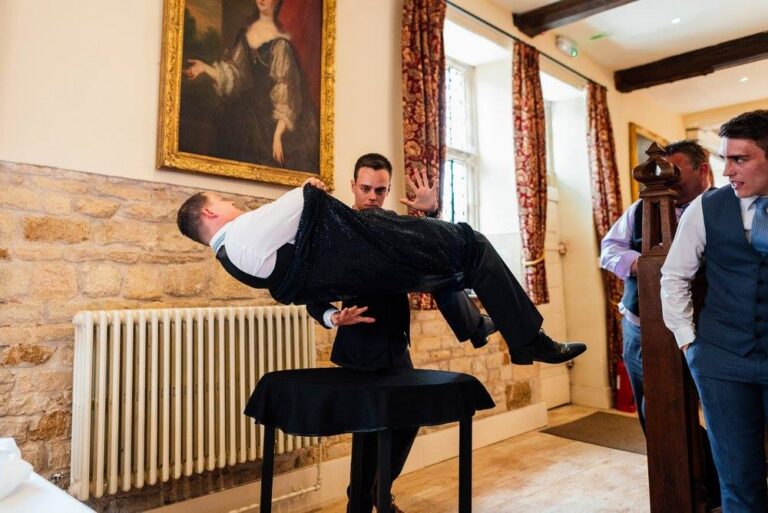
Roaming entertainers suit a summer party because guests are spread across a large area. A close-up magician, a caricaturist or a stilt walker can move to wherever people are gathering, rather than everyone having to crowd round a stage.
Family-friendly sessions work well if staff can bring children. A separate area with a children's entertainer, face painting or a bouncy castle lets parents relax. If you go this way, make sure anyone working directly with children is properly vetted and insured.
Ideas for awards nights and formal dinners
Awards nights follow a set pattern: arrival drinks, dinner, awards, then a party. The entertainment needs to fit around that structure rather than compete with it.
Arrival drinks are the moment to get people mingling. Roaming magic or live acoustic music works well here because guests are standing, arriving at different times and often wondering who to talk to.
During dinner, keep it gentle. Table-to-table magic between courses is popular because each table gets its own moment, and it fills the gaps while the kitchen catches up.
Before or after the awards, a short stage act can lift the room. A comedy magician or a mind reader performing a 20 to 30 minute set gives everyone a shared experience, and a good performer will bring a few colleagues up on stage in a way that's fun rather than embarrassing.
After the awards, hand over to a DJ or band. They've been sat down for hours and most will be itching to move.
Making sure everyone feels included
The most common complaint about work parties is that they revolve around drinking. Offer good alcohol-free options, not just orange juice, and plan at least one part of the evening that doesn't rely on a bar.
Avoid entertainment that relies on picking on individuals or that could cross a line at work. Brief any comedian or host on the audience, and ask them to keep material suitable for a mixed workplace crowd. A good pro will ask you about this before you even raise it.
Think about timing too. Events that run straight from work suit people with long commutes or caring duties better than late starts, and finishing at a sensible hour means more people will come.
Practical planning tips
Get the venue's rules early, especially on noise, power and whether outside suppliers need to send public liability insurance. Many corporate venues will ask for this before letting any entertainer through the door.
Set a budget per head and decide what matters most. A single strong act that everyone sees is usually better value than several small things that half the room misses. For corporate magic specifically, our corporate magician page explains the different formats and our price guide covers typical costs.
Afterwards, ask for feedback. A two-question survey tells you what to repeat next year, and it shows staff the night was for them.